SWE-bench scores show up in nearly every coding agent launch. We read all 500 tasks in SWE-bench Verified, the version most often quoted. They come from 12 Python projects, nearly half from Django, and most of the reference fixes are small. In 2026 OpenAI stopped reporting Verified, citing flawed tests and models that had seen the answers. A score is a starting filter. A trial on your own issues, with a person reviewing every change, is the real test.
The agent proposes patches. A person reviews each one and decides which agent the team adopts.
What SWE-bench is (checked on 2026-10-30)
SWE-bench gives a model a real GitHub issue and the repository as it was before the fix. The model writes a patch, and hidden tests from the real fix decide whether it resolved the issue. The code is MIT-licensed. Its scoring runs in Docker and the README recommends about 120 GB of free disk, so we did not run it. We read the datasets instead.
The SWE-bench site lists several leaderboards. The ones you will see most:
- SWE-bench (full): 2,294 test tasks from 12 Python repositories.
- Lite: 300 tasks, "curated for less costly evaluation".
- Verified: 500 tasks, "a human-filtered subset of 500 instances from SWE-bench, created in collaboration with OpenAI".
- Bash Only: the same 500 Verified tasks, with every model run in one minimal agent so models can be compared directly. The site calls it "the default Verified view".
The Verified page says its main leaderboard mixes "simple LM agent loops" with "multi-rollout and review type systems". So a Verified score measures a model plus the system around it.
Based on SWE-bench, by Carlos E. Jimenez, John Yang and colleagues.
The setup at a glance
- Trigger: your team is choosing between coding agents.
- Permissions: for the trial, a branch or fork of your own repository. No merge rights.
- Output: a short list of agents to trial, and a pull request from each for the same real issues.
- Human approval: a developer reviews every patch, and the team lead decides which agent to adopt. No agent merges its own work.
Step 1: Check which score you are looking at
When a launch post quotes a SWE-bench number, find out:
- Which split: full, Lite, Verified or another. They are different task sets.
- Which setup: the vendor's own agent, or the Bash Only view where every model gets the same minimal agent.
- Whether the run was checked by the SWE-bench team. The leaderboard has a marker for "Run performed or directly checked by the SWE-bench team".
Step 2: See what the tasks look like
You can read the tasks without Docker. This is the check we ran:
curl -s "https://datasets-server.huggingface.co/size?dataset=princeton-nlp/SWE-bench_Verified"
curl -s "https://datasets-server.huggingface.co/rows?dataset=princeton-nlp/SWE-bench_Verified&config=default&split=test&offset=0&length=100"
Each row has the repository, the issue text, the reference fix, the tests and a difficulty label. The dataset page shows the same rows in a browser.
Step 3: Run a trial on your own issues
Pick five to ten closed issues from your own repository that your team fixed recently. Give each agent the issue text and the code before the fix, on a branch. A developer reviews each patch as they would a colleague's: does it fix the issue, does it pass your tests, would you merge it.
What our check showed
| Check | Result |
|---|---|
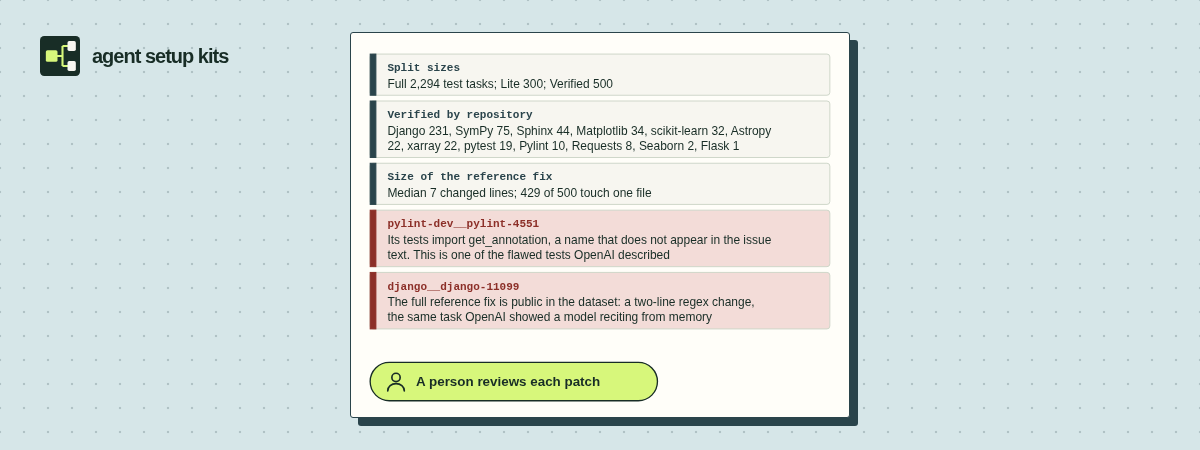
| Split sizes | Full 2,294 test tasks; Lite 300; Verified 500 |
| Verified by repository | Django 231, SymPy 75, Sphinx 44, Matplotlib 34, scikit-learn 32, Astropy 22, xarray 22, pytest 19, Pylint 10, Requests 8, Seaborn 2, Flask 1 |
| Language | All Python |
| Difficulty labels | 194 under 15 minutes, 261 from 15 minutes to an hour, 42 from 1 to 4 hours, 3 over 4 hours |
| Size of the reference fix | Median 7 changed lines; 429 of 500 touch one file |
| Issue dates | 2013 to 2023 |
pylint-dev__pylint-4551 | Its tests import get_annotation, a name that does not appear in the issue text. This is one of the flawed tests OpenAI described |
django__django-11099 | The full reference fix is public in the dataset: a regex fix of 2 changed lines, the same task OpenAI showed a model reciting from memory |
Things to know
- Verified is mostly short Python fixes in well-known open-source projects. If your work is a different language, a private codebase or larger changes, the score tells you less.
- In a post dated February 23, 2026, "Why we no longer evaluate SWE-bench Verified", OpenAI said it audited 138 Verified tasks that OpenAI o3 "did not consistently solve over 64 independent runs", a 27.6% subset of the dataset, and found 59.4% had material problems in tests or descriptions. It also said every frontier model it tested could reproduce some reference fixes or task text, and it stopped reporting Verified.
- In a post dated July 8, 2026, "Separating signal from noise in coding evaluations", OpenAI estimated that about 30% of SWE-bench Pro tasks are broken and withdrew its earlier recommendation of Pro.
- A higher score from a bigger system (many attempts, extra review steps) can cost more per task. The leaderboard has cost charts, such as "Resolved vs average cost" and "Cumulative cost distribution"; check them.
- Close scores are not meaningful differences. Use the leaderboard to build a short list, then trial.
Takeaway
SWE-bench Verified measures short Python fixes in 12 public projects, with known test flaws and contamination. Use scores to narrow the field, then let a developer review each agent's patches on your own issues before anyone adopts one.
Next step: pick five recently closed issues from your own repository and run your two shortlisted agents on them, on a branch, with a person reviewing every patch.
How we check the tools we list is on our verification page.
Good setups, worth keeping. Request email updates on the home page, then confirm by email. No subscription starts until you confirm. Or find an agent for the job.