faster-whisper can turn speech into text on an ordinary CPU with a 75 MB model. We ran its smallest model over eight minutes of public audiobook clips with known transcripts. It took about 20 seconds and got about one word in ten wrong, but a fresh install would not run at all, and with default settings one run went up to 29% word errors.
The human step: a person reads the transcript, and any summary made from it, before relying on names, numbers or quotes. In this test a script counted the errors against the published transcripts.
Based on faster-whisper, by SYSTRAN and contributors, under the MIT licence, checked with version 1.2.1, with the tiny model (MIT), a conversion of OpenAI's Whisper; and Ollama, by the Ollama contributors, under the MIT licence, checked with 0.40.13, both run locally. Checked 2026-10-31.
The test
- Audio: 73 clips, 481 seconds in all, of one reader from LibriSpeech (CC BY 4.0) dev-clean, taken from a small copy on Hugging Face. Each clip comes with a published transcript of 1,150 words in total.
- Model: the tiny model, int8, on an 8-core CPU, English set, beam size 5. The model file is 75.5 MB. The Python packages came to 572 MB.
- Scoring: our script uppercases both texts, drops punctuation, treats "Mr" as "Mister" and counts word errors (words swapped, dropped or added).
- Names: before any run we listed 10 names from one chapter, a review of a book by Harry Quilter, and checked which came through spelled right.
- Summary: we asked qwen2.5:3b through Ollama to summarize that chapter twice, once from the published text and once from our transcript.
The qwen2.5:3b weights are under the "Qwen RESEARCH LICENSE AGREEMENT", for non-commercial use only; check the model card before any commercial use.
The install did not work as published
pip install faster-whisper==1.2.1 pulled PyAV 19.0.2, and the first transcription failed with "open() got an unexpected keyword argument 'metadata_errors'". The PyAV changelog for 19.0.0 lists that argument as removed. A user reported the error, and a fix was merged on 30 September 2026, but it was not in a release on the day we checked: 1.2.1 was still the latest. Pinning av==18.1.0 fixed it for us, and 17.1.0 also worked.
The script
# Transcribe 73 LibriSpeech dev-clean clips with faster-whisper tiny and count word errors.
import io, json, re, sys, time
import pyarrow.parquet as pq
from faster_whisper import WhisperModel

def norm(s):
    words = re.sub(r"[^A-Z' ]", " ", s.upper().replace("-", " ")).split()
    return ["MISTER" if w == "MR" else w.strip("'") for w in words]

def edits(r, h):
    d = list(range(len(h) + 1))
    for i in range(1, len(r) + 1):
        prev, d[0] = d[0], i
        for j in range(1, len(h) + 1):
            prev, d[j] = d[j], min(d[j] + 1, d[j - 1] + 1, prev + (r[i - 1] != h[j - 1]))
    return d[len(h)]

model = WhisperModel("tiny", device="cpu", compute_type="int8")
rows = pq.read_table("dev.parquet").to_pylist()
out, err, ref_words, audio, start = [], 0, 0, 0.0, time.time()
for row in rows:
    segs, info = model.transcribe(io.BytesIO(row["audio"]["bytes"]), language="en", beam_size=5)
    hyp = " ".join(s.text.strip() for s in segs)
    r, h = norm(row["text"]), norm(hyp)
    e = edits(r, h)
    err, ref_words, audio = err + e, ref_words + len(r), audio + info.duration
    out.append({"id": row["id"], "ref": row["text"], "hyp": hyp, "errors": e, "words": len(r)})
took = time.time() - start
json.dump(out, open("hyp.json", "w"), indent=1)
labels = json.load(open("labels.json"))
chap = [o for o in out if o["id"].startswith(labels["chapter"])]
text = " ".join(re.sub(r"'S$", "", w) for w in norm(" ".join(o["hyp"] for o in chap)))
print(f"clips {len(out)} audio {audio:.1f}s transcribe {took:.1f}s")
print(f"WER {err}/{ref_words} = {100 * err / ref_words:.1f}%")
print("clips with 0 errors", sum(o["errors"] == 0 for o in out))
for name in labels["names"]:
    print("name", name, "kept" if f" {name} " in f" {text} " else "lost")
for o in chap:
    if o["errors"]:
        print(o["id"][-4:], o["errors"], "|", o["hyp"])
The run with temperature fallback off was the same script with temperature=0.0 added to the transcribe call.
Results
| Run | Settings | Word errors | Time |
|---|---|---|---|
| Development | default | 13.3% | 21.0 s |
| 1 | default | 29.0% | 23.0 s |
| 2 | default | 10.3% | 20.1 s |
| 3 | temperature 0.0 | 10.3% | 20.4 s |
| 4 | temperature 0.0 | 10.4% | 19.1 s |
Times are for transcription only, on a machine that was also doing other work. Every run used the same audio and model.
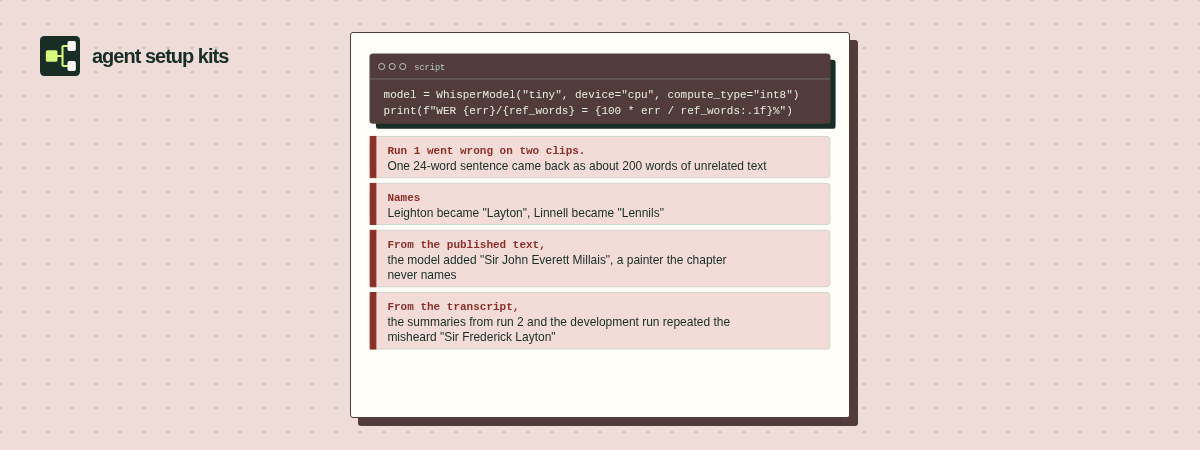
Run 1 went wrong on two clips. One 24-word sentence came back as about 200 words of unrelated text, and another sentence came back as two full stops. By default faster-whisper retries a clip at a higher temperature when the first decode looks poor, and that retry samples at random. That appears to explain why runs 1 and 2 differed so much. With the fallback off, the two runs were within one error of each other, and small wording differences remained.
Names: in run 2, 6 of the 10 listed names came through spelled right. Leighton became "Layton", Linnell became "Lennils", Tupper became "tougher", and Michael Angelo became "Michelangelo", which is arguably a fair modern spelling. Ordinary words slipped too: "mantel board" became "mental board".
The summary
The summary settings were temperature 0 and a fixed seed. Two problems showed up:
- From the published text, the model added "Sir John Everett Millais", a painter the chapter never names, in runs 1 and 2, which gave the same summary. The development run, with the same input, gave a different summary without him.
- From the transcript, the summaries from run 2 and the development run repeated the misheard "Sir Frederick Layton" and said "Harry Quilter praises the work of Mr. Quilter". Run 1's summary, from the transcript with the two failed clips, left Leighton out. In the development run the summary also turned the misheard "itals" into "Mason's Italian paintings".
A summary cannot fix a name the transcript got wrong, and a small model can add names of its own.
What this test does not show
- Your audio. These are clean studio readings by one speaker. Phone calls, meetings and accents will do worse.
- Larger models. We kept to tiny, the only model under our 100 MB limit. Larger Whisper models are more accurate and slower.
- Long files. Each clip is under 30 seconds. We did not test hour-long recordings.
- GPU speed. Everything ran on CPU.
What to set up
- Pin your audio library. Until a faster-whisper release includes the fix, pin
avbelow 19. - Turn off temperature fallback if you want repeatable output, and check whether accuracy holds on your audio.
- Test on audio you have a transcript for. A few minutes is enough to see the error rate before trusting it.
- Check names and numbers by hand. Those are the words a summary will carry forward.
- Keep the model offline. Download it once and set
HF_HUB_OFFLINE=1, as our test did.
Takeaway
faster-whisper's tiny model transcribed eight minutes of clean speech in about 20 seconds on CPU with about 10% word errors, once we pinned PyAV. With default settings one run reached 29%, and names were the weak spot, which the summary repeated in two of three runs. Turn off the fallback, pin the dependency and check names before you use the text.
Next step: record two minutes of your own audio, type the transcript, and score the tiny model on it before choosing a bigger one.
How we check the tools we list is on our verification page.
Good setups, worth keeping. Request email updates on the home page, then confirm by email. No subscription starts until you confirm. Or find an agent for the job.